
Pruning
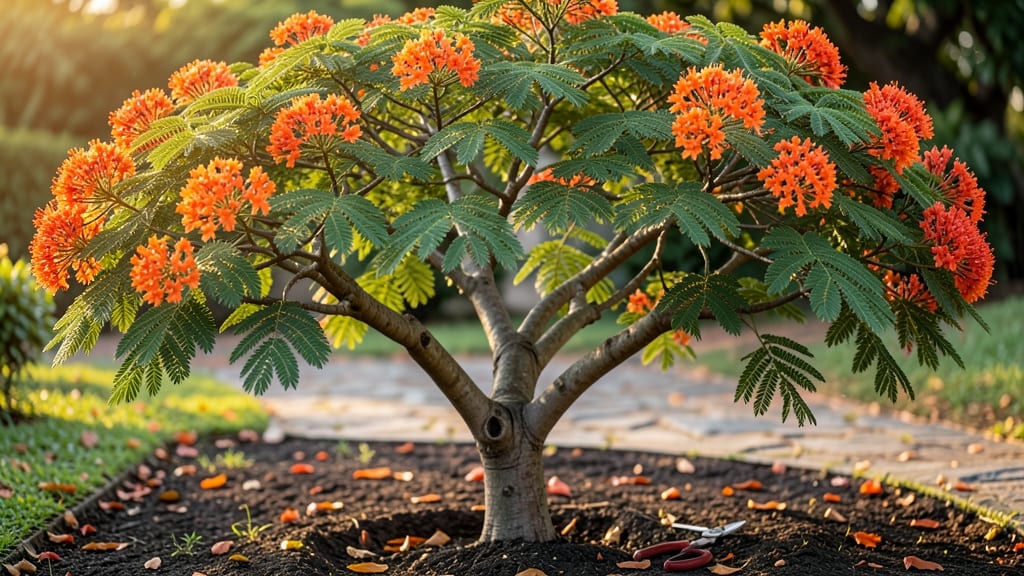
Royal poinciana tree care starts with understanding its fiery, tropical personality—those brilliant orange-red blooms won’t appear without the right balance of pruning, sunlight, and patience.
I’ve watched mine transform from a bare-branched skeleton in winter to a flaming canopy by summer, and the secret lies in year-round maintenance that keeps it healthy, not just decorative. The tree thrives in full sun but needs strategic cuts to prevent weak growth, especially after its dramatic flowering season.
What most people miss is how aggressive pruning in late winter actually encourages stronger blooms later.
You’ll need sharp pruning shears, a ladder (for mature trees), and a clear day to avoid spreading disease—royal poincianas bleed sap when cut, but that’s normal. The best time to prune is right after flowering, when the tree’s energy shifts from blooms to new growth.
Remove dead branches first, then thin out crowded areas to improve airflow; aim for an open, vase-like shape. For frost-sensitive zones, protect young trees with burlap wraps if temps drop below 30°F, though established trees handle cold surprisingly well once established.
What you’ll end up with is a tree that bursts into color every spring, its branches heavy with blossoms that last for weeks. The foliage stays lush and glossy, and the wood becomes sturdy enough to support its own weight—no more worrying about limbs snapping in storms.
Even in drought-prone areas, royal poincianas adapt once their roots establish, making them a low-maintenance showstopper for warm climates.
Here’s the kicker: this tree rewards patience. First-year pruning sets the stage for decades of vibrant displays, but the real magic happens in years two and three when the root system matures.
If you’re in a colder zone, consider growing it in a large container where you can winter it indoors—though nothing beats the spectacle of a mature specimen lighting up a landscape. Let’s get those shears ready.
📚 In This Guide
- What you need
- Instructions
- Tips and common mistakes
- Wrapping up and next steps
What you need
- ● Pruning shears: Bypass pruners (sharp, 6–8" blades) for small branches.
- ● Loppers: Heavy-duty (20–24" handles) for medium branches (½–2" diameter).
- ● Pruning saw: Curved-tooth saw for thick branches (2" or larger).
- ● Ladder: Sturdy, extendable (16–20 ft) for high branches.
- ● Gloves: Heavy-duty work gloves (cut-resistant) to protect hands.
- ● Disinfectant: 70% isopropyl alcohol or bleach solution (1:9 ratio) to sterilize tools.
- ○ Pruning sealant: Optional but helpful (latex-based) for large cuts.
- ● Heavy-duty trash bags: For collecting debris (3–5 large bags).
- ● Safety gear: Safety glasses, long sleeves, and closed-toe shoes.
- ● Tree wrap: For protecting young trunks from sun scorch.
- ● Mulch: Organic mulch (2–3 inches) to retain moisture.
- ● Fertilizer: Slow-release, balanced fertilizer (10-10-10 ratio) for post-pruning care.
- ● Watering can/hose: For post-pruning hydration.
- ● Extension cord: If using an electric pruner.
Step-by-Step guide for pruning royal poinciana trees
Here's how to maintain your stunning flamboyant tree year-round for bold blooms and sturdy branches.
✂️ Step 1: Assess the Tree Structure Before Pruning
Start by examining your royal poinciana in late winter or early spring, just as new growth begins. Look for dead, diseased, or crossing branches—these are your first targets. I always scan from the ground up, using a pair of binoculars if the tree is large, to spot hidden issues in the canopy. Healthy branches should have smooth bark and vibrant green leaves, while dead wood feels brittle and snaps easily when tested.
Identify the main scaffold branches—the thick, sturdy limbs that form the tree's framework. These should be spaced evenly around the trunk and angled outward. If you notice any branches growing inward or rubbing against others, mark them for removal. This prevents future wounds and maintains the tree's natural shape. I like to sketch a quick diagram of the tree's structure to visualize the final shape before making any cuts.
✂️ Step 2: Remove Dead, Diseased, or Weak Branches
Begin pruning by cutting out any dead, diseased, or weak branches first. Use sharp, clean pruning shears or a pruning saw for larger branches. Make your cuts just outside the branch collar—the swollen area where the branch meets the trunk or another branch. This ensures the tree can seal the wound properly and prevents decay from entering the trunk.
For larger branches over 2 inches in diameter, use the three-cut method to avoid tearing the bark. First, make an undercut about 1-2 feet out from the trunk on the side opposite the branch's direction. Next, cut about 1 foot out from the trunk on the branch's top side. Finally, make a final cut just outside the branch collar, allowing the branch to fall cleanly away. This method prevents the bark from splitting and gives the tree a smooth healing process.
✂️ Step 3: Thin the Canopy for Better Airflow and Light
Once you've removed the dead or diseased branches, focus on thinning the canopy to improve airflow and sunlight penetration. Aim to remove about 20-30% of the tree's foliage during this step. Start at the outer edges and work your way inward, cutting back branches that are growing too densely. This encourages new growth on the interior branches and reduces the risk of fungal diseases.
Look for branches that are growing straight up or downward—they often compete with others for resources and can create a weak structure. Cut these back to a lateral branch that grows outward. Avoid over-thinning, though; royal poincianas thrive on lush foliage, so leave enough leaves to maintain the tree's vibrant appearance. If you're unsure, step back and assess the tree from a distance—you should still see plenty of green, but with more even spacing between branches.
✂️ Step 4: Shape the Tree for Balance and Aesthetics
Now it's time to refine the tree's shape. Royal poincianas have a natural, open growth habit, so avoid heavy pruning that could make the tree look too dense or unnatural. Focus on maintaining an open center by removing any branches that grow too close to the trunk or others. This prevents future crowding and makes it easier to care for the tree as it matures.
If your tree has become too tall or leggy, you can lightly prune the top to encourage bushier growth. However, avoid heavy topping—this can shock the tree and lead to weak, water-sprout growth. Instead, make small cuts just above a lateral branch or bud to redirect the tree's energy. Always step back and admire your work from a distance to ensure the tree maintains its natural beauty and structural integrity.
⏰ Step 5: Post-Pruning Care for Healthy Recovery
After pruning, give your royal poinciana some extra care to ensure a smooth recovery. Water the tree deeply to help it recover from the stress of pruning, especially if you've made large cuts. Apply a balanced, slow-release fertilizer around the base of the tree to support new growth. I like to use a 10-10-10 or 8-3-9 formula in early spring to give the tree a nutrient boost without overloading it.
Monitor the tree closely in the weeks following pruning. Watch for signs of stress, such as yellowing leaves or wilting, which could indicate over-pruning or disease. If you notice any issues, adjust your care routine accordingly—this might include additional watering, mulching, or even another round of targeted pruning to remove any problem areas. With proper care, your royal poinciana should reward you with stunning blooms and strong, healthy growth for years to come.
Tips & tricks for perfect royal poinciana tree care
Here's what I've learned after years of nurturing these magnificent trees—tricks that'll keep your royal poinciana thriving with minimal stress.
Pruning Tool Precision: Invest in high-quality, sharp pruning tools—dull blades tear bark and create larger wounds that heal poorly. I always clean my tools with rubbing alcohol between cuts to prevent spreading disease. For branches over 2 inches, the three-cut method in Step 2 is non-negotiable; I've seen too many trees develop ugly bark tears from improper cuts. Remember, clean cuts heal faster and look more professional.
Seasonal Timing Insight: The late winter to early spring timing in Step 1 is perfect because the tree is dormant but about to burst with new growth. This gives it time to recover before summer's heat. I've noticed that pruning too early can expose fresh cuts to winter cold, while waiting too late risks encouraging new growth that might not harden off before frost. The sweet spot is just as buds begin to swell.
Canopy Thinning Strategy: When aiming for that 20-30% foliage reduction in Step 3, focus on removing entire branches rather than just trimming leaves. This maintains the tree's natural structure while improving airflow. I often use a string line technique—tie a line between two outer branches, then remove any branches that cross this line. It creates an instant visual guide for even spacing and prevents over-thinning.
Post-Pruning Recovery Boost: After completing all steps, I've found that applying a thin layer of arborist's wound dressing to larger cuts in Step 5 helps prevent decay. While the tree can seal wounds naturally, this extra protection gives it a head start, especially in humid climates. Pair this with the recommended deep watering and fertilizer application, and you'll see new growth emerge within weeks rather than months.
Pro Tips for Royal Poinciana Tree Care
- Here's what I've learned after years of nurturing these magnificent trees—tricks that'll keep your royal poinciana thriving with minimal stress.
- Pruning Tool Precision: Invest in high-quality, sharp pruning tools—dull blades tear bark and create larger wounds that heal poorly.
- Seasonal Timing Insight: The late winter to early spring timing in Step 1 is perfect because the tree is dormant but about to burst with new growth.
Frequently asked questions
Got questions about keeping your Royal Poinciana tree thriving? You’re not alone! Here are answers to the most common concerns—from pruning tips to troubleshooting—so you can enjoy its stunning blooms year-round.
When is the best time to prune a Royal Poinciana tree?
The ideal time to prune is late winter or early spring (before new growth starts). Avoid pruning during the blooming season (summer/fall) to preserve flowers. Light trimming for safety or shape can happen year-round, but major pruning should wait until dormancy. Pro tip: Prune on a dry, sunny day to reduce disease risk!
How much can I trim back my Royal Poinciana tree?
You can safely remove up to 30% of the tree’s foliage per year without stressing it. For structural pruning, focus on removing dead, diseased, or crossing branches first. Avoid over-pruning—this tree thrives with a balanced canopy. Warning: Never remove more than 25% in one season unless reviving a severely neglected tree.
Why are the leaves on my Royal Poinciana tree turning yellow or dropping?
Yellowing or dropping leaves often signal overwatering, underwatering, or pests. Check soil moisture—Royal Poincianas prefer well-draining soil and hate soggy roots. Common culprits:
- Scale insects (sticky residue on branches)
- Spider mites (fine webbing)
- Root rot (mushy stems, foul smell)
Can I grow a Royal Poinciana tree in a container?
While possible, Royal Poincianas are large, fast-growing trees (30–50 ft tall) and thrive best in ground planting. If container-grown, use a 50+ gallon pot with drainage holes and tropical potting mix. Limitations:
- Root-bound trees bloom less vigorously.
- Requires yearly repotting to prevent circling roots.
- Needs full sun and regular fertilization (e.g., 20-20-20 NPK).
How do I protect my Royal Poinciana tree from frost or cold weather?
Royal Poincianas are tropical/subtropical and cannot tolerate frost (below 30°F). If you live in a cold climate:
- Plant in a sheltered, microclimate spot (e.g., near a south-facing wall).
- Mulch the base with 3–4 inches of organic mulch to insulate roots.
- Cover young trees with burlap or frost cloth during hard freezes.
- Consider container growing and winterizing indoors (if small).
Wrapping up and next steps
Caring for your Royal Poinciana tree is all about balance—pruning at the right times, providing the right nutrients, and staying attentive to its needs.
With the right techniques, you’ll enjoy stunning blooms and lush foliage year after year! 🌺 Now that you’re armed with expert tips, take action: schedule your next pruning session and watch your tree thrive under your care.
Need a refresher? Bookmark this guide and revisit it before your next pruning adventure. Happy gardening!