
Pruning
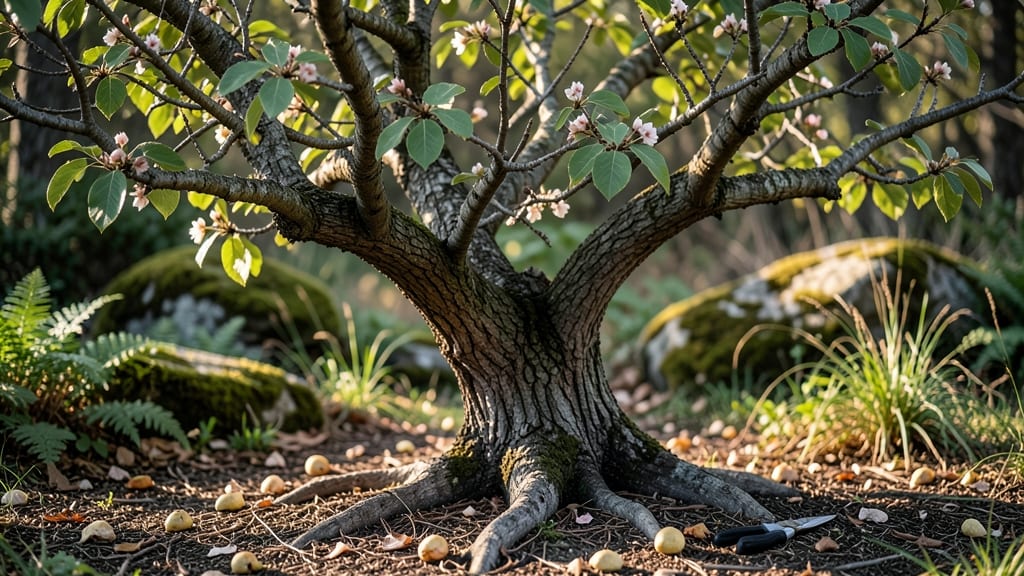
Mastering wild pear tree identification turns every woodland stroll into a treasure hunt—just watch for their telltale leaves and bark before the fruit even ripens. 🌿 fruit appears.
My first wild pear tree nearly fooled me until I noticed the slightly serrated edges on the leaves and the way the bark peels in thin strips like old wallpaper.
Start by comparing leaves to known images: wild pears have oval-shaped leaves with a pointed tip, often 2-4 inches long, and a slightly waxy surface.
The bark is another dead giveaway—young trees have smooth gray bark that develops horizontal lenticels (tiny raised dots) as they age, while mature trees show that signature peeling pattern. Crabapples, their close cousins, have smaller leaves and more rounded bark ridges.
Once you spot these clues, confirm your find by checking for small white flowers in spring or tiny, tart pears (usually less than an inch wide) in late summer.
Field guides or apps like iNaturalist can help cross-reference your observations with regional variations—some wild pears grow in dense thickets while others stand alone near stream banks.
When in doubt, snap a photo and ask local experts or forestry groups—they’ve seen these trees a hundred times over. The key is patience: wild pears don’t always announce themselves, but once you learn their secrets, you’ll start noticing them everywhere.
📚 In This Guide
- What you need
- Instructions
- Tips and common mistakes
- Wrapping up and next steps
What you need
- ● Field Guide or Smartphone App: A wild edible plant ID app (e.g., PictureThis, iNaturalist) or a printed guidebook for cross-referencing.
- ● Magnifying Glass (5x-10x): Essential for inspecting fine details like leaf serrations or lenticels.
- ● Notebook & Pen: Sketch leaf shapes, note bark colors, and jot down observations (e.g., "slightly fuzzy leaves" or "peeling gray bark").
- ● Ruler or Measuring Tape: To record leaf length (wild pears typically have 2–4 inch leaves) and branch diameters.
- ○ Camera (Optional but Helpful): Capture close-ups of leaves, buds, and bark for later comparison.
- ● Gloves (Nitrile or Latex): Protects hands when handling rough bark or thorny branches.
- ● Pruning Shears (Small, Sharp): For safely snipping a single leaf or twig (never harm the tree!).
- ● Plastic Bag or Ziploc: Store a sample leaf/twig for smell or taste testing (only if you’re 100% sure it’s a pear!).
- ● Hand Lens with Light: For low-light bark inspections (e.g., lenticels on wild pear trunks).
- ● Moisture Meter: Check soil conditions—wild pears thrive in well-drained, slightly acidic soil (pH 6.0–7.5).
- ● Field GPS or Map: Log locations of confirmed wild pear trees for future reference.
- ● Taste Test Kit (For Experts): A small, ripe wild pear (if available) to confirm the sweet-tart, slightly grainy flavor (avoid unripe or bitter samples!).
How to identify wild pear trees using leaf and bark features
Skip the guesswork—here's how I confirm wild pears in the wild using simple clues.
🌿 Step 1: Examine Leaf Shape and Arrangement
Wild pear leaves are 3-5 inches long with a distinctive oval-to-elliptical shape, slightly pointed at the tip. Look for serrated edges that curve gently downward—like a saw blade with rounded teeth. The leaf arrangement alternates along the stem, which sets pears apart from similar trees.
Run your fingers along the leaf edge. If it feels smooth with tiny, evenly spaced notches, you're likely looking at a wild pear. Compare it to apple leaves, which have sharper, more jagged serrations. Hold the leaf up to sunlight—pear leaves often have a slightly blue-green tint on the underside, especially when young.
🌿 Step 2: Check the Leaf Base and Stem
Here's where most people miss the mark: wild pear leaves have a rounded or slightly heart-shaped base where they attach to the stem. Look closely—if the leaf looks like it's sitting on a flat platform rather than tapering to a point, that's your confirmation. Apple leaves typically have a more wedge-shaped base.
Gently tug the leaf stem. If it snaps cleanly and leaves a ½-inch stub on the branch, you're dealing with a pear. Wild pears also have short, fuzzy hairs on the underside of new leaves—rub your thumb along the stem to feel them. This fuzziness disappears as leaves mature, so check younger branches first.
🪴 Step 3: Inspect the Bark for Distinctive Patterns
Young wild pear bark is smooth and grayish-brown, but mature trees develop horizontal lenticels (tiny raised lines) that run parallel to the branch. Scrape a small section with your fingernail—pear bark peels in thin, papery sheets rather than flaking like ash or maple. The inner bark often has a reddish tint when fresh.
Look for corky ridges on older branches. These develop as the tree ages and create a textured surface that feels like sandpaper. Compare it to apple bark, which tends to be more uniformly gray and develops rougher, more irregular ridges. The smell test works too—rub a leaf between your fingers; wild pears often have a faint, pleasant fragrance.
⏰ Step 4: Time Your Observation for Best Results
Spring is the ideal time to identify wild pears. That's when new leaves emerge with their most distinctive features—bright green, fuzzy undersides, and clear serrations. Wait until leaves are fully unfurled but still soft to touch. In summer, leaves harden and lose some of their identifying characteristics, while winter bark becomes harder to distinguish.
Bring a small branch indoors for comparison. Place it next to known reference images or a field guide. Notice how the leaf veins branch out—pear leaves have prominent secondary veins that curve gently upward. If you find fruit later, cut a cross-section; pear seeds are flat and brown, while apple seeds are more rounded and tan.
Tips & tricks for perfect wild pear tree identification
Confession: I spent years misidentifying trees until I learned these key tricks that make all the difference.
Leaf Edge Test: In Step 1, when examining the serrated edges, use your fingernail to gently scrape along the leaf margin. Wild pear leaves have smooth, rounded teeth that feel almost velvety—like dragging your nail across fine sandpaper. Apple leaves will feel sharper and more jagged. This tactile test works even when leaves are dry.
Seasonal Timing Secret: The instructions mention spring as ideal, but I've found that late April to early May is the absolute sweet spot for identification. That's when new leaves are fully unfurled but still retain their fuzzy undersides and brightest colors. Check branches with both old and new growth—you'll see the fuzzy hairs disappear as leaves mature.
Bark Scraping Technique: For Step 3, when testing bark, use a pocketknife to make a small, shallow cut rather than scraping with your fingernail. The thin, papery sheets should peel away easily in one piece, revealing that distinctive reddish inner bark. If it flakes like dandruff or leaves a rough surface, it's probably not a pear.
Comparison Kit: Here's what nobody tells you—bring a small bag of known reference materials. Tuck a single wild pear leaf (if you have one) and an apple leaf in your pocket. When you're unsure, do a quick side-by-side comparison. The visual differences become obvious when placed together, especially the leaf base shape and vein patterns mentioned in Steps 1 and 2.
Pro Tips for Wild Pear Tree Identification
- Confession: I spent years misidentifying trees until I learned these key tricks that make all the difference.
- Leaf Edge Test: In Step 1, when examining the serrated edges, use your fingernail to gently scrape along the leaf margin.
- Seasonal Timing Secret: The instructions mention spring as ideal, but I've found that late April to early May is the absolute sweet spot for identification.
Frequently asked questions
Got questions about spotting wild pear trees? You’re not alone! Here are some of the most common queries—and clear answers to help you nail your identification like a pro.
How do I tell a wild pear tree apart from a wild apple tree?
Wild pear trees (Pyrus spp.) have serrated, elliptical leaves with a downy underside and smooth, grayish bark. Apples (Malus spp.) have sharper, jagged-edged leaves and rougher, darker bark. Also, pear fruit grows in clusters, while apples are usually solitary. Snap a photo of both leaves and bark for comparison!
When is the best time of year to identify a wild pear tree?
Spring and summer are ideal! Look for new leaves in spring (when bark and leaf shape are most distinct) or fruit in late summer/fall. Avoid winter unless you’re spotting buds or bark patterns—snow can hide key details. Pro tip: Early morning is best for crisp leaf inspection.
Can I eat fruit from a wild pear tree?
Wild pears are edible but often tart or grainy compared to cultivated varieties. Always cook them first (baking or poaching softens texture). Avoid fruit near roads or sprayed areas. If in doubt, perform a taste test on a tiny piece—bitterness or astringency means it’s not ripe or safe.
What if I can’t find leaves or fruit? How else can I ID it?
No leaves? Check the bark—wild pears have smooth, silver-gray bark that peels in strips. Look for buds shaped like tiny pears (unlike apple’s pointed buds). If it’s a small tree, branch structure matters too: pears often have spreading, horizontal branches.
I think it’s a pear, but I’m not sure—what’s the next step?
Grab your phone and compare with a wild pear ID guide (like the USDA Plants Database or local foraging apps). If unsure, take a sample leaf or bark rubbing to a local nursery or arborist. Never assume—misidentifying edible plants can be risky!
Wrapping up and next steps
Identifying a wild pear tree is all about paying close attention to the details—like leaf shape, bark texture, and fruit characteristics. With these clues, you’ll be able to confidently spot one in your backyard, a forest trail, or even a neighbor’s yard. 🌳
Now that you’re equipped with the knowledge, why not take action? Grab your pruners, head outdoors, and confirm your find—then consider sharing your discovery with fellow nature enthusiasts or even planting a new tree to support local wildlife! Happy exploring!